


 Day Dresses
 Midi Dresses
 Maxi Dress
 Cocktail Dresses
 Party Dresses
 Occasion
 Wedding Guest
 Church & Special Events
 Co-Ord Sets
 Evening Dresses
 Embellished
 Rhinestone & Crystal
 Sequins
 Lace
Lace Satin
Satin Velvet
 Statement Sleeves
 Structured
 Black Tie
 Formal
 Designer
 Couture-Inspired
 Crystal & Hand-Embellished
 Exclusive Pieces
 Birthday
 Race Day
 Graduation
 A-Line
 Bodycon
 Wrap
Wrap

 Occasion Jumpsuits
 Evening Jumpsuits
 Trouser Sets
 Blazer Sets
 Skirt Sets
 Earrings
 Bracelets
 Bags
Bags Cluctches
How to Power Dress for Corporate Success in 2026


Standing in front of your closet on a Monday morning, the pressure to look polished and powerful can feel overwhelming. For professional women in the United Kingdom and Ireland, every corporate event or client meeting is a chance to showcase confidence and leadership through personal style. Building a strategic wardrobe tailored to your workplace dress code and industry culture ensures you shine at each opportunity, and this guide brings together the best advice on selecting statement pieces, coordinating details, and maintaining a power look that truly works.
Table of Contents
- Step 1: Assess Your Corporate Wardrobe Needs
- Step 2: Select Statement Pieces For Impact
- Step 3: Coordinate Accessories And Details
- Step 4: Check And Refine Your Power Look
Quick Summary
| Key Concept | Explanation |
|---|---|
| 1. Identify Your Dress Code | Research your workplace’s dress code by reviewing company policies or observing colleagues. This step helps tailor your wardrobe appropriately. |
| 2. Evaluate Existing Wardrobe | Conduct a thorough audit of your current clothing to assess fit and condition, ensuring everything is suitable for your professional needs. |
| 3. Choose Strategic Statement Pieces | Select statement pieces that reflect your personal style while maintaining professionalism, enhancing your overall appearance effectively. |
| 4. Coordinate Accessories Thoughtfully | Pay attention to accessories that complement your outfits without overshadowing them, focusing on quality and coherence. |
| 5. Regularly Refine Your Wardrobe | Schedule periodic assessments of your wardrobe to ensure items remain relevant and reflective of your evolving professional profile. |
Step 1: Assess Your Corporate Wardrobe Needs
Assessing your corporate wardrobe needs is where everything starts. Before you buy anything new, you need to understand what your workplace actually requires from you.
Start by identifying your workplace dress code. This is not something to guess about. Look at your employee handbook, check your company’s intranet, or simply observe what colleagues wear on a daily basis. The differences between formal, business casual, and casual work environments are significant, and dressing appropriately matters more than you might think.
Formal environments demand structured, polished pieces. Business casual workplaces allow more flexibility while maintaining professionalism. Casual workplaces might seem relaxed, but dressing professionally still supports your career progression.
Here’s how different workplace dress codes influence wardrobe choices:
| Dress Code Type | Required Pieces | Style Emphasis |
|---|---|---|
| Formal | Tailored blazers, classic shoes | Structure, polish, tradition |
| Business Casual | Mix of blazers and knitwear | Professional, flexible |
| Casual Workplace | Polished basics, neat footwear | Relaxed, yet intentional |
Next, assess what you already own. Pull everything from your closet and organize it by these categories:
- Blazers and structured jackets
- Trousers and skirts in neutral colors
- Blouses and shirts
- Dresses suitable for professional settings
- Footwear (heels, flats, professional boots)
- Outerwear and accessories
Be honest about condition and fit. Items that no longer fit properly or show wear don’t belong in a power wardrobe, no matter how much you spent on them originally.
Then consider your specific role and industry. A lawyer dresses differently from a marketing director, who dresses differently from a nonprofit administrator. Your job responsibilities, client interaction level, and organizational culture all influence what you need. Understanding essential wardrobe pieces ensures you invest in items that work across multiple situations.
Identify the gaps between what you own and what you need. Do you have enough blazers? Are your trousers in good repair? Are your shoes professional and comfortable? This gap analysis prevents wasteful shopping and keeps you focused on building a strategic wardrobe.
Your assessment now saves time and money later. A clear picture of your needs prevents impulse purchases that don’t fit your real life.
Pro tip: Take photos of your existing pieces laid flat or on hangers, then organize them by color and style in a digital folder on your phone—this makes it easy to check what you already have before shopping.
Step 2: Select Statement Pieces for Impact
Statement pieces are your secret weapon for standing out while remaining professional. These carefully chosen items communicate confidence, authority, and personal style without overwhelming your overall look.

Start by defining what a statement piece means for your role and industry. For a corporate lawyer, it might be a beautifully tailored blazer in deep burgundy or a structured dress with subtle texture. For a creative director, bolder patterns or unexpected colors work better. The key is choosing pieces that feel authentically you while respecting your workplace culture.
Your statement pieces should accomplish three things:
- Draw attention and create visual interest
- Maintain professionalism and corporate appropriateness
- Work with multiple outfits in your existing wardrobe
Invest in high-quality tailoring above all else. A well-fitted blazer in an unexpected color makes more impact than a poorly fitted dress in a trendy pattern. Strategic statement pieces elevate your overall appearance by balancing bold choices with polished restraint.
Consider these statement options that work across industries:
- A structured blazer in jewel tones, textured fabric, or interesting cut
- A patterned or colored blouse that coordinates with neutral bottoms
- A midi dress with subtle details you can layer with a simple cardigan
- Statement jewelry or scarves that add personality without distraction
- Unique footwear that feels professional yet distinctive
Pick one statement piece per outfit. If your blazer is bold, keep your blouse simple. If your shoes have personality, let your top be understated. This balance prevents your look from feeling chaotic or attention-seeking in the wrong way.
Test your statement pieces in advance. Wear them to less critical meetings first to see how they feel and how colleagues respond. You’ll quickly learn what works in your specific environment.
A statement piece is not about being bold for its own sake. It is about projecting confidence through intentional choices.
Pro tip: Choose your first statement piece in a neutral color with an interesting texture, pattern, or cut—this feels slightly adventurous while remaining easy to style with everything else in your wardrobe.
Step 3: Coordinate Accessories and Details
Accessories are where your power look comes together. The right details elevate your outfit from ordinary to polished, while the wrong ones can undermine everything you’ve chosen.
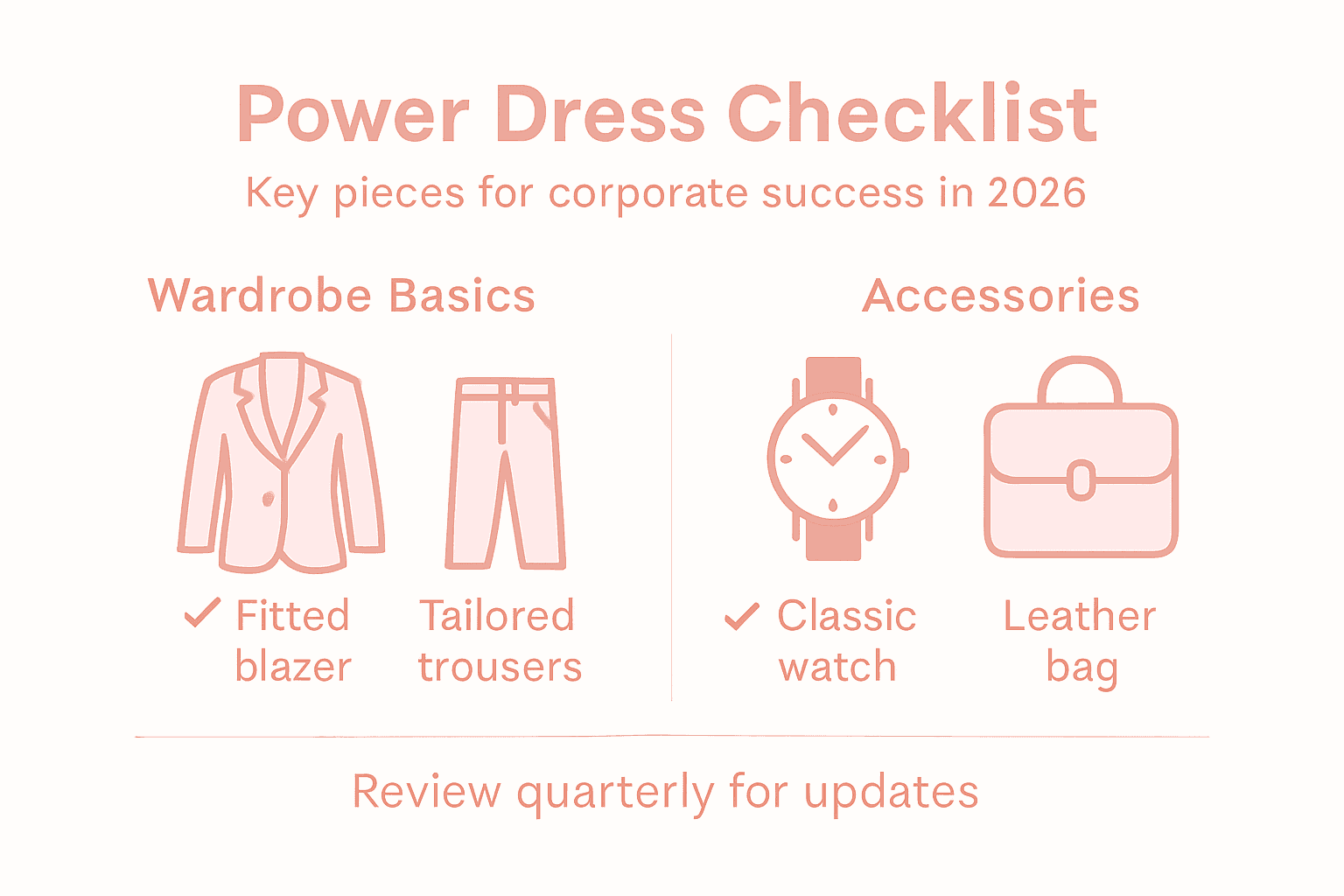
Think of accessories as the finishing layer that communicates attention and intentionality. When done well, they enhance your professional image without stealing focus from your message. Quality matters far more than quantity here.
Start with foundational pieces that work with everything:
- A classic watch in gold, silver, or rose gold
- A structured leather handbag in black, navy, or neutral tone
- Simple stud earrings or minimal necklaces
- A professional leather belt in black or brown
- Closed-toe shoes in neutral colors or subtle patterns
Professional accessories should reinforce your authenticity and professional goals rather than distract from them. Your jewelry should be understated enough that people notice you, not your necklace. Your bag should be functional and polished, not trendy or flashy.
Now layer in your personality through strategic details. A silk scarf worn as a neck tie, a patterned pocket square, or a pair of tailored eyeglasses can add character while maintaining professionalism. These touches show intention and personal brand awareness.
Pay close attention to often-overlooked details. Polished shoes matter tremendously. A visible stain or worn heel undermines your entire look. Your grooming sets the tone for how polished your accessories appear. Neat hair, clean nails, and minimal perfume create the canvas your accessories enhance.
Coordinate your metal tones consistently. If your watch is gold, carry a gold buckle on your belt and wear gold earrings. This cohesion creates visual harmony and communicates sophistication.
Details are where confidence lives. When every element coordinates intentionally, you project control and authority.
Pro tip: Invest in one high-quality leather bag and one excellent watch that work with your entire wardrobe—these two pieces anchor your professional image more than anything else.
Step 4: Check and Refine Your Power Look
Your power look is not static. As your career evolves and workplace expectations shift, your wardrobe must adapt alongside you. Regular checking and refining keeps your image sharp and relevant.
Start by scheduling a quarterly wardrobe audit. Pull out everything you wore in the past three months and assess honestly. Did these pieces make you feel confident? Did they get compliments? Did they align with your professional goals? Be ruthless about removing items that no longer serve you.
Check the condition of every piece. Worn heels, fraying seams, faded colors, and stretched fabrics undermine your authority instantly. If something needs repair, tailor it or discard it. A polished look means everything is in pristine condition.
Evaluate fit with fresh eyes. Your body changes, and trends in professional silhouettes shift. A blazer that fit perfectly two years ago might feel dated now. Building a work capsule wardrobe involves periodic assessment to ensure every piece still fits your current frame and reflects your evolving professional identity.
Consider these refinement checkpoints:
Below is a summary of power wardrobe refinement checkpoints and their impact:
| Refinement Checkpoint | Focus Area | Impact on Professional Image |
|---|---|---|
| Fit and Silhouette | Garments’ tailoring | Modern, confident appearance |
| Color Coordination | Outfit matching | Harmonious, sophisticated look |
| Garment Condition | Wear and care | Attention to detail, maintained status |
| Accessory Consistency | Metals/materials | Cohesion, visual polish |
- Do your colors still flatter your complexion and mood?
- Are your silhouettes current but timeless, not trendy?
- Does every piece coordinate with at least three other items?
- Are your shoes comfortable enough to wear all day?
- Do your accessories feel authentically you?
Replace items strategically as you identify gaps. If you’ve outgrown a favorite blazer, invest in a similar piece in an updated cut. If a blouse has become too pale, replace it with a richer shade. This intentional replacement prevents your wardrobe from becoming mismatched or dated.
Pay attention to how your outfits make you feel. Confidence is visible, and discomfort is equally visible. If something doesn’t feel right after wearing it, note it for potential replacement or refinement.
A refined wardrobe reflects intention. Every piece should earn its place by making you feel powerful and prepared.
Pro tip: Take a full-length photo of yourself in each outfit you wear to important meetings—after a month, review the photos to identify which combinations made the strongest visual impact.
Elevate Your Corporate Style with Confidence Today
Feeling overwhelmed by the challenge of building a powerful corporate wardrobe for 2026 is common. You want to assess your wardrobe needs correctly and find statement pieces that both fit your role and showcase your unique style. Dressing to command authority while maintaining professionalism is not easy. Yet mastering this balance can unlock new career opportunities and boost your confidence every day.
Discover how Womens Fashion at BeeCollectibles helps you refine your power look with carefully curated pieces designed for impact and versatility. Every item supports your journey to stand out with subtle sophistication. Start now to transform your wardrobe and experience the difference a strategic, polished look makes. Visit BeeCollectibles and take the first step to owning your professional image.
Frequently Asked Questions
How can I assess my corporate wardrobe needs?
Start by identifying your workplace dress code by reviewing your employee handbook, checking your company’s intranet, or observing what colleagues wear. Then, categorize your existing wardrobe into different types of clothing, such as blazers, trousers, and blouses, to identify gaps you need to fill.
What are statement pieces and how should I choose them?
Statement pieces are standout items that convey confidence and professionalism while respecting workplace culture. Choose pieces that are high-quality, fit well, and complement your existing wardrobe, such as a tailored blazer or a unique blouse, to enhance your overall appearance.
How should I coordinate accessories with my outfits?
Choose foundational accessories, such as a classic watch and a structured handbag, to elevate your professional look. Ensure that your accessories are cohesive in color and style, as this creates visual harmony and enhances your polished image in the workplace.
What should I include in a quarterly wardrobe audit?
During a quarterly wardrobe audit, assess the fit, condition, and relevance of each piece in your wardrobe. Remove any items that don’t fit well or make you feel confident, ensuring that your wardrobe reflects your evolving professional identity.
How can I refine my power look over time?
Regularly check and refine your wardrobe by evaluating the condition and fit of your garments. Remove outdated pieces and replace them strategically to ensure that your wardrobe continues to support your professional goals and makes you feel powerful in your appearance.
Dresses